National Action Plan on Antimicrobial Resistance 2.0
National Action Plan on Antimicrobial Resistance (NAP-AMR) (2025-2029) One Health Approach
Antimicrobial Resistance (AMR) refers to the condition when the routinely used medicines like antibiotics, antivirals, antiparasitic drugs, or antifungals become ineffective for treating the respective organisms.
Antimicrobial Resistance (AMR) is recognized as an emerging public-health threat globally with serious health and economic implications.
The Global Burden Disease study on antimicrobial resistance conducted in 2021 reported that 4.71 million deaths were associated with bacterial AMR including 1.14 million deaths attributable to bacterial AMR.
A multi-facility retrospective observational study was conducted in 10 hospitals in India to assess the mortality burden associated with multidrug-resistant (MDR) and extensively drug-resistant (XDR) infections between January and December 2015 11 . A total of 19,811 antimicrobial susceptibility test (AST) results were obtained from 13,086 patients. Of these, 5,103 records met all inclusion criteria for the analysis. The overall mortality rate among these patients was 13.1% (581 deaths).
If the current trends continue, AMR may lead to difficulty in treating common infections, uncertainty in success of high-end procedures, longer hospital stays and more expensive treatments. AMR poses growing threat not just to humans but also to plant and animal health due to interconnected ecosystems and therefore needs to be addressed through a ‘One Health’ approach involving coordination and collaboration among multiple stakeholders.
The National Action Plan on Antimicrobial Resistance was developed in alignment with WHO’s Global action plan on AMR and launched in the year 2017. NAP AMR 1.0 defined the priorities and interventions planned to be implemented over 2017 – 2021 to tackle AMR in India.
The process of developing the NAP AMR 2.0 was initiated in June 2022 and a series of national expert consultations were held towards its development.
To continue the fight against AMR through one Health approach, a more practical NAP AMR 2.0 (2025-2029) has been prepared. The ‘One Health’ approach in this action plan has sectoral action as the foundation of intersectoral collaboration and coordination among human, animal, agriculture, environmental and other relevant sectors over the next 5 years.
Ministry of Health and Family Welfare (MoHFW) through its various departments and organizations has committed action across all the strategic objectives of this action plan.
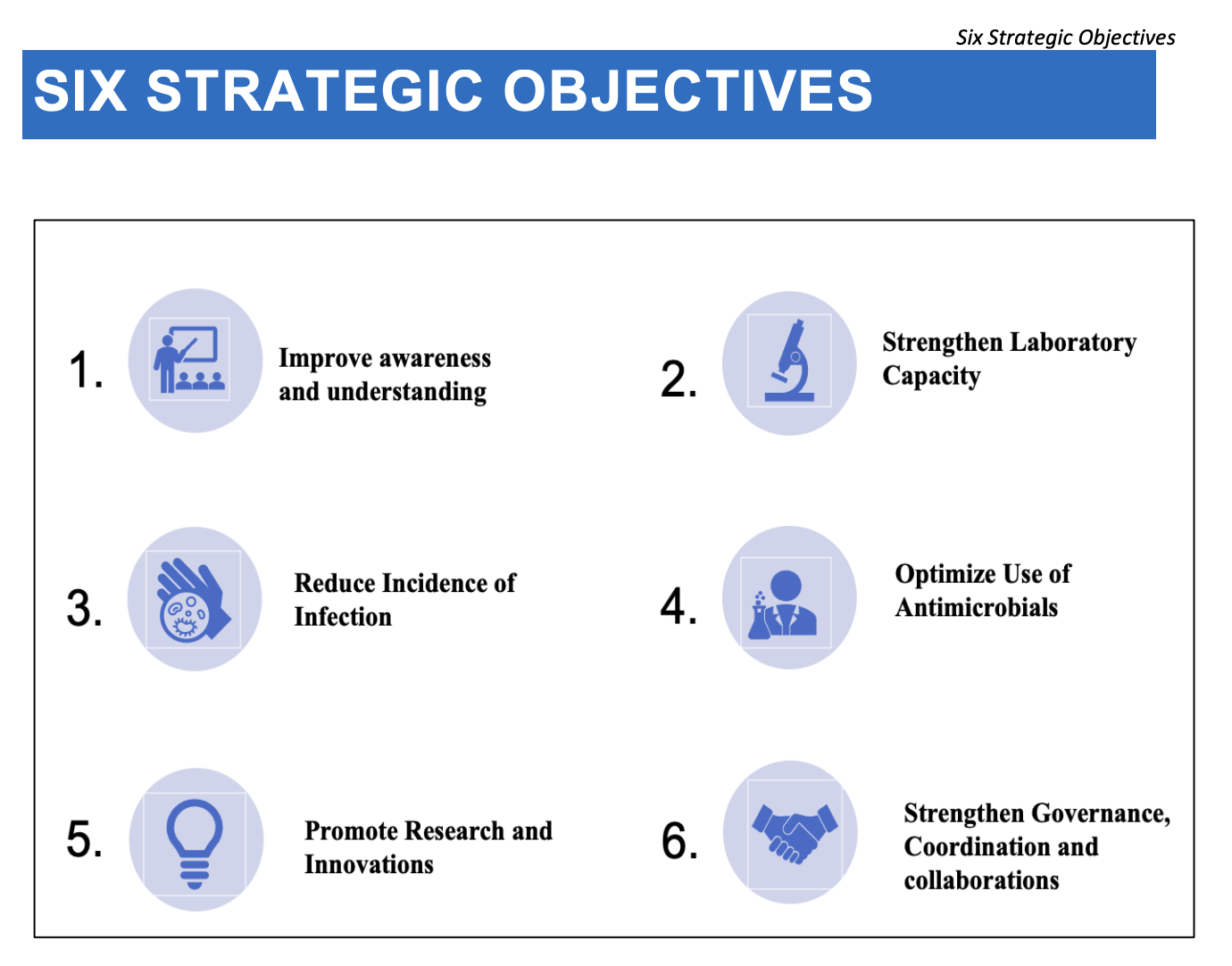
The NAP-AMR 2.0 is based on ‘Whole of government’ approach with sustained funding within each sector/department and effective sectoral action as the foundation of intersectoral coordination. The National Strategy for AMR Containment defines the goal of AMR Containment in India. It also describes the six strategic objectives with sub-objectives and key activities to be undertaken with a ‘One Health’ approach.
Vision
Create a sustainable ecosystem for humans, animals, plants and environment by preventing emergence and transmission of AMR through effective sectoral and Multisectoral evidence-based ‘One Health’ approach.
Goal
Protect the health of humans, animals, plants and environment through improving awareness and education, strengthening laboratory capacity for AMR detection, prevention of infections, uninterrupted access to and appropriate use of antimicrobials, effective research and innovation and coordination and collaboration.

You may also like

Genome India Project

UPSC CMS Aspirants Beware: AI Answers Can Cost You Marks