


UPSC: Guardian of India’s Steel Frame of Governance
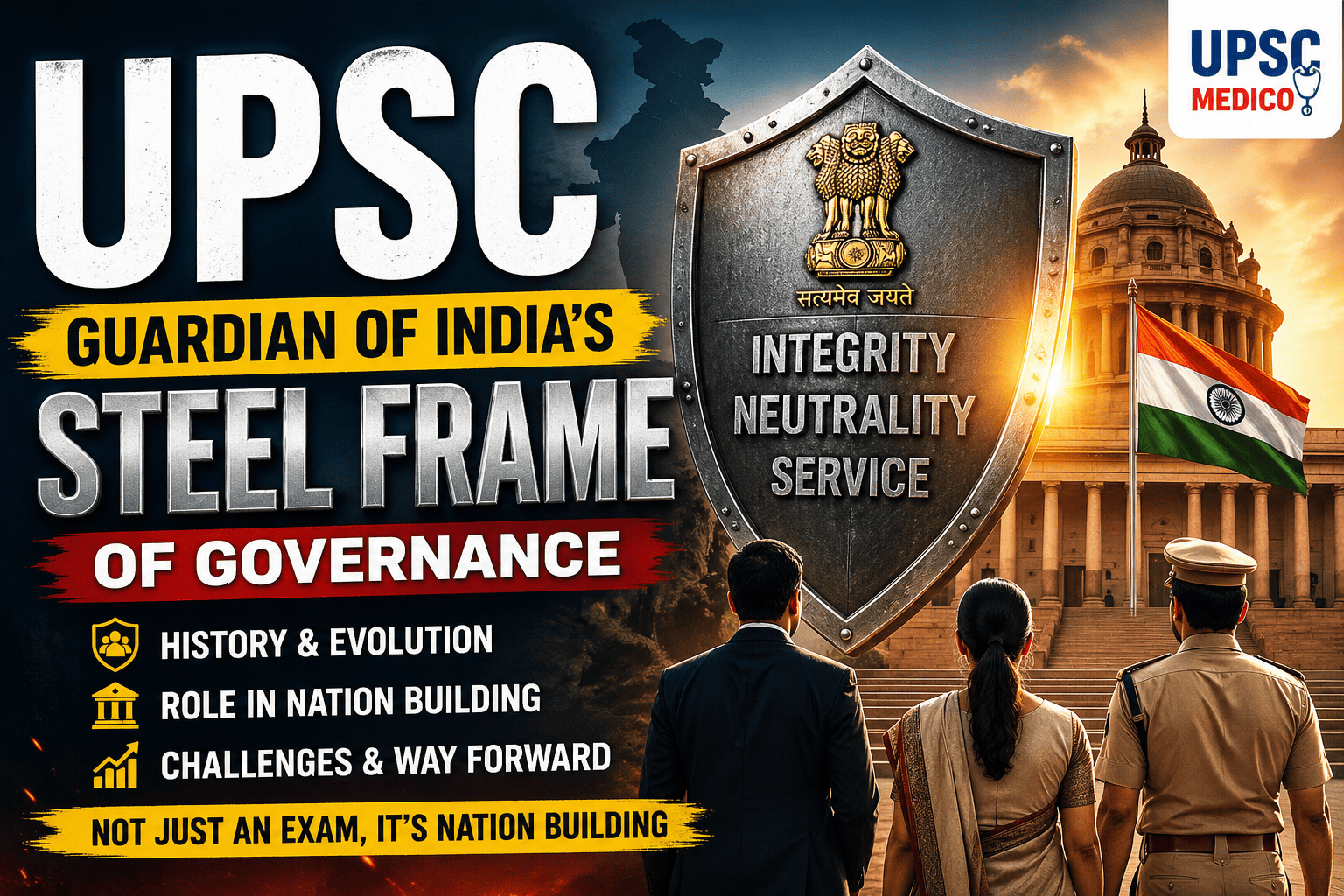
India’s democratic strength does not rest only on its Constitution or its electoral processes—it rests equally on the quiet, persistent machinery of governance that translates vision into action. At the heart of this machinery stands the Union Public Service Commission (UPSC), an institution often described as the “guardian of India’s steel frame.” This phrase, originally associated with the civil services, captures the resilience, neutrality, and continuity that keep the nation functioning through changing political tides.
Historical Foundations: From Colonial Tool to Democratic Pillar
The origins of UPSC trace back to the British era, when the need for a merit-based administrative system began to take shape. The Indian Civil Service (ICS), introduced in the 19th century, was initially designed to serve colonial interests. However, it gradually evolved into a system that emphasized merit, competitive examinations, and administrative competence.
Key milestones include:
- 1854 Macaulay Committee Report: Introduced open competitive examinations.
- 1919 Government of India Act: Recommended the establishment of a Public Service Commission.
- 1926: The first Public Service Commission was set up in India.
- 1935 Government of India Act: Expanded its role and autonomy.
After independence, the framers of the Constitution recognized the need for an impartial and robust recruitment body. Thus, under Articles 315–323, UPSC was established as a constitutional body in 1950, ensuring independence from executive interference.
What was once a colonial administrative tool transformed into a democratic institution tasked with selecting individuals who would serve the people of India with integrity and efficiency.
UPSC and the Steel Frame: Why It Matters
The phrase “steel frame” signifies stability, strength, and continuity. Civil servants selected through UPSC form this backbone by:
- Ensuring policy continuity despite political changes
- Maintaining administrative neutrality
- Implementing laws and welfare schemes effectively
- Acting as a bridge between government and citizens
From managing disasters to implementing flagship schemes like health missions, digital governance, and rural development programs, civil servants play a pivotal role in shaping everyday life in India.
UPSC ensures that this cadre is not just academically capable, but also ethically grounded and socially aware. Its rigorous three-stage examination—Prelims, Mains, and Interview—tests not just knowledge, but judgment, empathy, and leadership.
Challenges in the Modern Era
Despite its strengths, the UPSC system faces evolving challenges:
- Changing governance demands: Today’s administrators must understand technology, climate change, geopolitics, and public health.
- Coaching culture vs true learning: The rise of rote preparation sometimes dilutes analytical thinking.
- Diversity and representation: Ensuring inclusivity across regions and socio-economic backgrounds remains a continuous goal.
- Administrative inertia: Even capable officers may struggle within rigid bureaucratic structures.
The Way Forward: Strengthening the Steel Frame
To remain relevant and effective in the 21st century, UPSC and the civil services must evolve:
1. Competency-Based Evaluation
Move beyond memory-heavy exams to test problem-solving, ethics, and real-world decision-making.
2. Continuous Training and Specialization
Introduce domain expertise in areas like AI, healthcare, environment, and economics—transforming generalists into “informed specialists.”
3. Technological Integration
Encourage digital governance skills, data-driven policymaking, and innovation in public administration.
4. Ethical Reinforcement
Strengthen integrity through training, accountability mechanisms, and institutional culture.
5. Lateral Entry with Balance
Allow domain experts into governance while preserving the neutrality and continuity of career civil servants.
Conclusion: A Living Institution
UPSC is not just an exam-conducting body—it is a gatekeeper of India’s administrative conscience. It ensures that those who enter public service are not merely job seekers, but nation builders.
As India aspires to become a global leader, the role of UPSC becomes even more critical. The steel frame must not only remain strong—it must become smarter, more agile, and deeply aligned with the aspirations of 1.4 billion people.
In the end, the true strength of this steel frame lies not in its rigidity, but in its ability to adapt without breaking—firm in principle, yet flexible in action.

You may also like
