UPSC CMS Aspirants Beware: AI Answers Can Cost You Marks
A reality check every serious UPSC CMS aspirant must read:
Artificial Intelligence tools like ChatGPT, Claude, and others are rapidly becoming a part of every student’s preparation strategy. From solving MCQs to explaining complex concepts, AI seems like the perfect study partner.
But here’s the uncomfortable truth:
AI is not always aligned with UPSC standards.
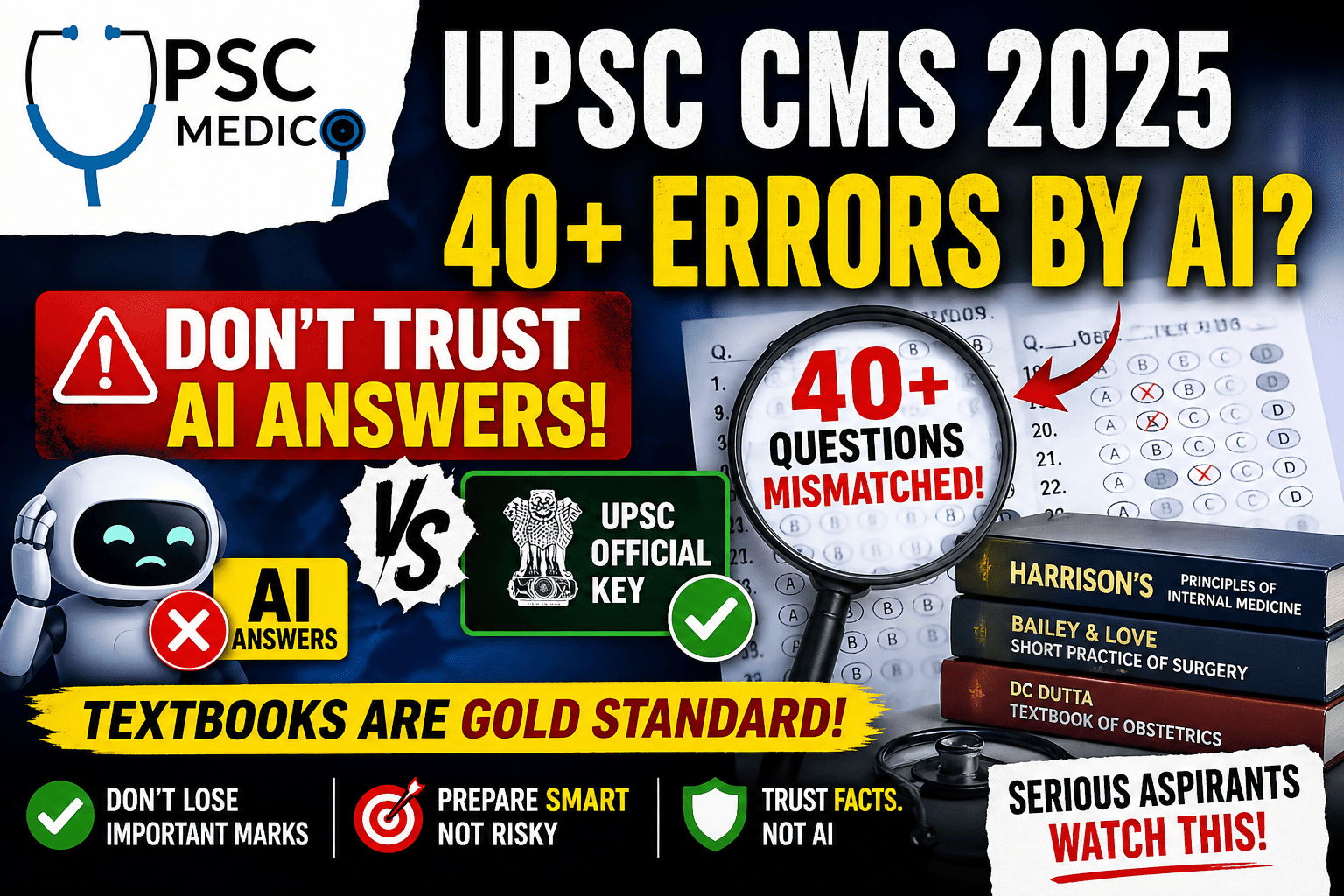
During a detailed analysis of the UPSC CMS 2025 question paper, a significant mismatch was observed between AI-generated answers and the official UPSC answer key.
And this is not a minor issue—it can directly impact your marks, rank, and final selection.
The Shocking Finding: 40+ Errors in a Single Paper
When the UPSC CMS 2025 paper (240 questions) was evaluated using multiple AI platforms:
- 40+ questions showed clear discrepancies
- That’s nearly 16–17% error rate
- In simple terms: 1 out of every 6 answers could be wrong
For a competitive exam where even 5–10 marks can change your rank, this is a serious concern.
AI tools are powerful—but they are not exam authorities. Their limitations include:
1. Probabilistic Nature
AI predicts the most likely answer based on patterns—not necessarily the officially accepted answer.
2. Lack of Exam-Specific Alignment
UPSC follows:
- Standard textbooks
- Conventional clinical interpretations
- Established academic consensus
AI does not always prioritize these.
3. Ambiguity in Medical Science
Medicine is full of:
- Multiple correct approaches
- Context-dependent answers
AI may pick a clinically reasonable answer that is not the exam answer.
4. No Accountability
UPSC has a defined answer key.
AI does not.
The Hidden Risk for Aspirants
If you rely blindly on AI for:
- ❌ Previous Year Question (PYQ) validation
- ❌ Final answer confirmation
- ❌ Choosing between close options
You may:
- Build incorrect concepts
- Develop wrong answer patterns
- Lose precious marks in the exam
Remember: UPSC rewards precision, not approximation.
Why Textbooks Are Still the Gold Standard
Despite technological advancements, standard textbooks remain the most reliable source.
Why?
✔️ They form the basis of UPSC questions
✔️ They provide standardized, accepted knowledge
✔️ They are peer-reviewed and academically validated
Common gold-standard sources include:
- Medicine: Harrison’s Principles of Internal Medicine and Davidson
- Surgery: Bailey & Love
- Obstetrics & Gynecology: Dutta
- Pediatrics: OP Ghai
- PSM: Park
UPSC does not change its answers based on AI. It follows textbooks.
This is not an anti-AI message. It’s about using AI intelligently.
Use AI for:
- Concept simplification
- Quick revision
- First-level doubt clarification
- Memory aids and summaries
Avoid AI for:
- Final answer validation
- PYQ answer keys
- Critical decision-making in MCQs
Trust, but verify—always with standard sources.
“AI can assist your preparation, but it cannot replace authentic sources.”

You may also like
Genome India Project