BRICS Health Cooperation 2026: Key Health Initiatives and Policy Updates
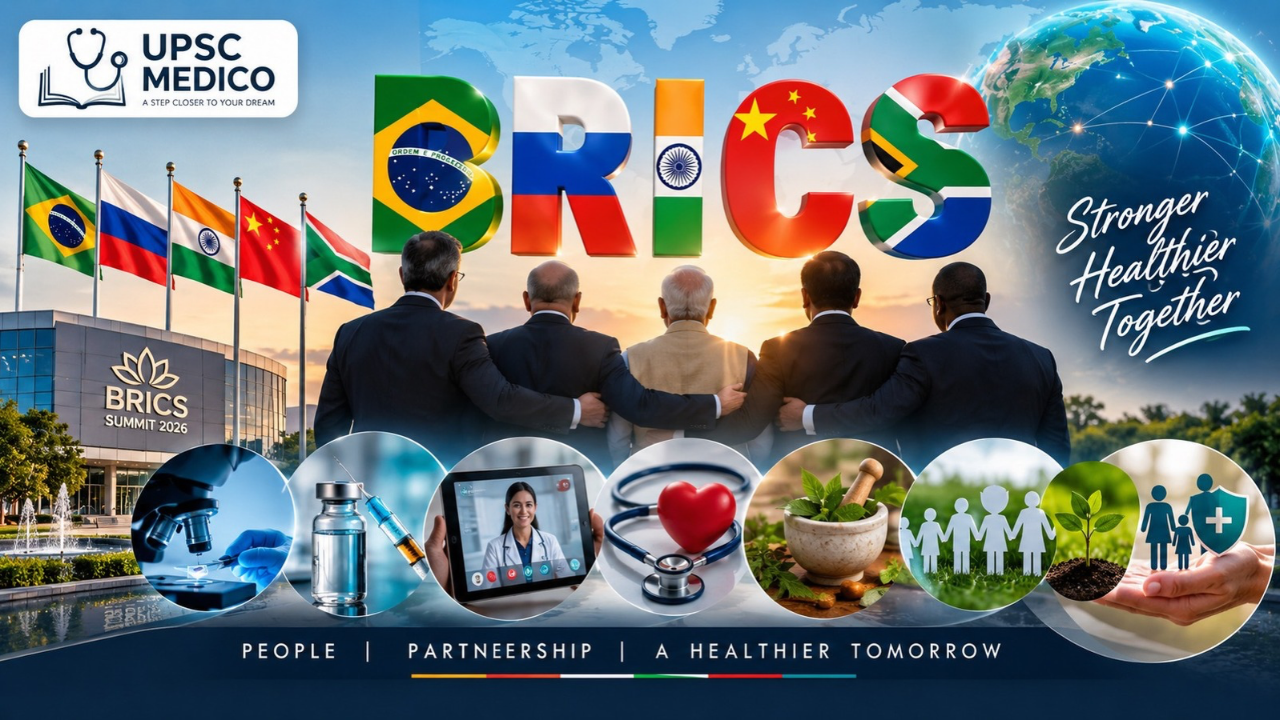
The 2026 BRICS Summit, held under India’s chairship, placed significant emphasis on strengthening health cooperation among BRICS countries. The health agenda focuses on Universal Health Coverage, health equity, pandemic preparedness, digital health, disease prevention, affordable medical technologies, mental health, traditional medicine and collaborative research.
The BRICS Health Working Group identified nine priority areas for cooperation:
- BRICS TB Research Network
- Collaboration among Medical Products Regulatory Authorities
- BRICS Integrated Early Warning System for Mass Infectious Diseases
- Digital Health Architecture
- BRICS Mission for Healthy Lifestyle
- Mental Health and Wellness
- Traditional, Complementary and Integrative Medicine (TCIM)
- Diseases Driven by Social Determinants of Health (DD-SDH); and the
- BRICS Network of National Public Health Institutes.
1. BRICS TB Research Network
The BRICS countries are strengthening collaboration in tuberculosis research because several BRICS nations carry a substantial proportion of the global TB burden. The network aims to promote collaborative research, operational research, development of new diagnostics, drugs and vaccines, knowledge sharing and equitable access to TB innovations.
2. Collaboration among Medical Products Regulatory Authorities
BRICS countries are promoting cooperation between their regulatory authorities for medicines, vaccines, diagnostics and medical devices. The objective is to share regulatory expertise, improve harmonisation of regulatory approaches, strengthen quality and safety standards and facilitate faster access to safe and effective medical products. A BRICS GxP White Paper has also been developed to consolidate regulatory best practices and technical approaches.
3. BRICS Integrated Early Warning System for Mass Infectious Diseases
BRICS is working towards strengthening early detection, surveillance, information sharing, risk assessment and coordinated response to infectious disease threats. A dedicated mechanism/sub-working group has been developed to advance cooperation on pandemic preparedness and outbreak response.
4. Digital Health Cooperation
Digital health has emerged as an important area of BRICS cooperation. The countries are promoting interoperable, people-centred digital health systems, particularly to improve continuity of care and access to healthcare in remote and underserved areas. India has highlighted initiatives such as the Ayushman Bharat Digital Mission (ABDM), Ayushman Arogya Mandirs and e-Sanjeevani as examples of digital and primary healthcare innovations.
A BRICS Compendium on Digital Health Architecture for Continuum of Care, including Access to Healthcare in Remote Areas, has also been developed.
5. BRICS Mission for Healthy Lifestyle
Healthy Lifestyle Promotion is one of the new priority areas introduced under India’s BRICS chairship. The initiative focuses on prevention and control of non-communicable diseases (NCDs) by promoting physical activity, healthy diets and other healthy behaviours while addressing major risk factors such as tobacco use, harmful alcohol use, obesity and physical inactivity.
A BRICS Roadmap for Joint Initiative on Healthy Lifestyle Promotion (2026–2029) and a compendium of replicable best practices have been developed.
6. Mental Health and Mental Wellness
Mental health and wellness is another new priority area under India’s chairship. BRICS is establishing a BRICS Network of Centres of Excellence on Mental Wellness to promote collaboration in mental-health research, training, capacity building, evidence-based interventions and integration of mental health into primary healthcare.
NIMHANS, Bengaluru, has been designated as the Coordinating Centre for this BRICS Network of Centres of Excellence on Mental Wellness. A BRICS Training Hub Network is also being developed to strengthen mental-health workforce capacity.
7. Traditional, Complementary and Integrative Medicine (TCIM)
BRICS has established an Expert Working Group on Traditional, Complementary and Integrative Medicine (TCIM). Cooperation includes research, evidence generation, clinical validation, quality and safety, pharmacovigilance, regulatory standards, academic exchange and protection of traditional knowledge. Traditional medicine received a dedicated section in the 2026 BRICS Health Ministers’ Declaration.
8. Diseases Driven by Social Determinants of Health
BRICS has adopted an Operational Framework to Fight Diseases Driven by Social Determinants of Health (DD-SDH). The initiative recognises that health outcomes are influenced by determinants such as poverty, nutrition, housing, education, sanitation, environment, occupation and access to healthcare. It promotes multisectoral action and a stronger focus on health equity.
9. BRICS Network of National Public Health Institutes
BRICS is strengthening networking among National Public Health Institutes to facilitate collaboration in public-health surveillance, research, outbreak preparedness, public-health intelligence, capacity building and evidence-based policymaking.
Other Important BRICS Health Cooperation Areas
In addition to the nine priority areas, BRICS continues to promote cooperation in vaccine research and development, antimicrobial resistance (AMR), nuclear medicine, pandemic preparedness, affordable medicines, vaccines and diagnostics, medical technologies and Universal Health Coverage (UHC).
The BRICS Vaccine Research and Development Centre remains an important mechanism for collaborative vaccine research and pandemic preparedness.
Important Indian Institutions to Remember
- JIPMER, Puducherry – Participates in the BRICS Network University (BRICS-NU), Health Sciences thematic area, facilitating academic, research, training and institutional collaboration among BRICS countries.
- Institute of Postgraduate Medical Education & Research (IPGME&R/SSKM), Kolkata – Participates in the BRICS Network University – Health Sciences collaboration.
- NIMHANS, Bengaluru – Coordinating Centre for the BRICS Network of Centres of Excellence on Mental Wellness.
The overall objective is to build resilient, equitable, innovative and sustainable health systems through greater cooperation, knowledge sharing, research, technology transfer and capacity building among BRICS countries.