


UPSC CMS 2026 paper and key PDF download
PEDIATRICS (24 QUESTIONS: KEY SET C)
Question:
A 6-year-old boy is brought with complaints of involuntary, non-rhythmic, jerky movements of upper limbs and snorting sounds, noticed for the past 12 months. His MRI brain and EEG are normal. The child was mocked at by classmates in school and he stopped attending classes for the past 6 months. His ASLO titres and serum ceruloplasmin are non-contributory. The ideal therapy would be a trial of:
Options:
Answer:
Question:
A 4-year-old unimmunized HIV-positive child on antiretroviral therapy for the last 2 years and weighing 15 kg is brought for vaccination. His records reveal a recent CD4 count of 750/mm³, with no evidence of any opportunistic infections in the past. Which of the following statements are applicable to this child?
- Recombinant Hepatitis B vaccine can be safely administered.
- MMR vaccine is always contraindicated.
- BCG may be administered if chest radiograph is normal.
- IPV is preferred over OPV.
Select the correct answer using the code given below:
Options:
Answer:
Question:
As per the National Immunization Schedule, PCV (Pneumococcal Conjugate Vaccine) is offered at:
Options:
Answer:
Question:
Which one of the following vaccines is an exception to the principle “At least 4 weeks interval is needed between two doses of the same vaccine to ensure adequate immune response”?
Options:
Answer:
Question:
Administration of immunoglobulins interferes with the response to live vaccines, except:
Options:
Answer:
Question:
A 14-year-old boy is reported by his neighbour to the police for repeated aggressive activities including beating up children in the neighbourhood. The boy’s neighbour also noticed that he also snorts heroin sometimes. He will be categorized legally as suffering from:
Options:
Answer:
Question:
As per the National Vector Borne Disease Control Programme, the first-line agent for treatment of Kala-azar (visceral leishmaniasis) is:
Options:
Answer:
Question:
Which one of the following illnesses is NOT covered under the Rashtriya Bal Swasthya Karyakram (RBSK)?
Options:
Answer:
Question:
A 2-year-old child is brought with complaints of not growing well. On examination, he weighs 8.1 kg, height 80 cm(Weight-for-Length score between 0 and –2 SD), has a Mid Upper Arm Circumference (MUAC) of 11.5 cm, and both palms are white. There is no oedema of the feet.
As per IMNCI, he will be classified as:
Options:
Answer:
Question:
A 2-year-old previously unimmunized girl is brought with poor feeding and fever for 6 days. On day 4 of fever, her mother noticed a maculopapular reddish rash starting from the face and spreading over the neck, chest, arms and trunk over the next one day, and she has developed extensive mouth ulcers. The child has a MUAC of 11 cm but no oedema.
As per IMNCI, she will be classified as:
Options:
Answer:
Question:
A term neonate weighing 2 kg, delivered to a primigravida mother through vaginal route and clear liquor, is found to have gasping respiratory efforts after performing the initial steps in the delivery room.
The next step in resuscitation is:
Options:
Answer:
Question:
A newborn delivered at 37 weeks gestation with birth weight 2.7 kg presents at 12 hours of life with bilious vomiting. On examination, RR 36/min, HR 110/min, CRT <3 sec, abdominal distension present. Abdominal radiograph reveals multiple air-fluid levels with absent distal gas pattern.
The most likely etiology is:
Options:
Answer:
Question:
Consider the following statements regarding the management of tracheoesophageal fistula in neonates:
- The baby should be nursed in prone position.
- The neonate should be kept nil per orally and started on intravenous fluids.
- The neonate needs continuous oral suction using a slow suction device.
- Surgery should be planned once the neonate attains 2.5 kg weight.
Which of the statements given above are correct?
Options:
Answer:
Question:
An apparently well male neonate delivered by vaginal route in hospital is discharged at 2 days of life. He is brought to the outpatient department on day 4 of life as the mother complains of pink staining of his diapers. There is no bleeding from urethra or per rectum. Urine dipstick test for RBC is negative. The baby is appearing playful and active. The most likely etiology of pink staining of diapers is:
Options:
Answer:
Question:
A preterm neonate is brought to the emergency and body temperature is noted to be 32°C. Which one of the following metabolic complications is unlikely?
Options:
Answer:
Question:
A 5-year-old boy is brought to the outpatient department with complaint of developmental delay. He can feed himself with a biscuit, draw a line, can climb steps, and only says bisyllables. Which one of the developmental screening tools is NOT suitable for him?
Options:
Answer:
Question:
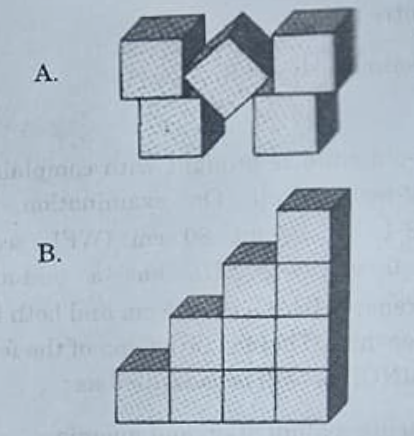
A 8-year-old girl is provided a low vision aid and asked to rotate the structure in the image provided. If she can rotate the structure A but cannot match the structure B, the fine motor developmental quotient (DQ) in the motor domain is:
Options:
Answer:
Question:
A 2-year-old boy was brought to the emergency when his mother noticed that he had developed dusky appearance and lethargy over the past 6–8 hours. The child had been prescribed some medicine for vomiting by a local practitioner. Examination revealed normal-sized liver, GCS 9, and shallow breathing with cyanosis. Arterial blood gas revealed PaO₂ of 80 mmHg and SpO₂ of 60%. Which one of the following drugs may be implicated?
Options:
Answer:
Question:
A 3-year-old boy presents with barking cough and noisy breathing for 2 days. He has a history of runny nose and fever for the preceding 3–4 days. Examination reveals a respiratory rate of 40/min, subcostal retractions and stridor. The most important step in management is:
Options:
Answer:
Question:
A 3-year-old boy presents to the emergency room with seizures. He has been receiving oral phenytoin since the age of 6 months and has a history of epileptic spasms despite phenobarbitone therapy. Examination reveals some hypopigmented lesions over the chest. Brain imaging shows subependymal nodules. Which one of the following is the best anti-epileptic drug for him after stabilization in the emergency room?
Options:
Answer:
Question:
A 12-year-old boy is brought to the emergency room in an unconscious state with a history of shallow breathing and increasing drowsiness for two hours. He is cold to touch, has pinpoint pupils, dry mouth, limp extremities and a respiratory rate of 8/min. Which one of the following antidotes should be administered?
Options:
Answer:
Question:
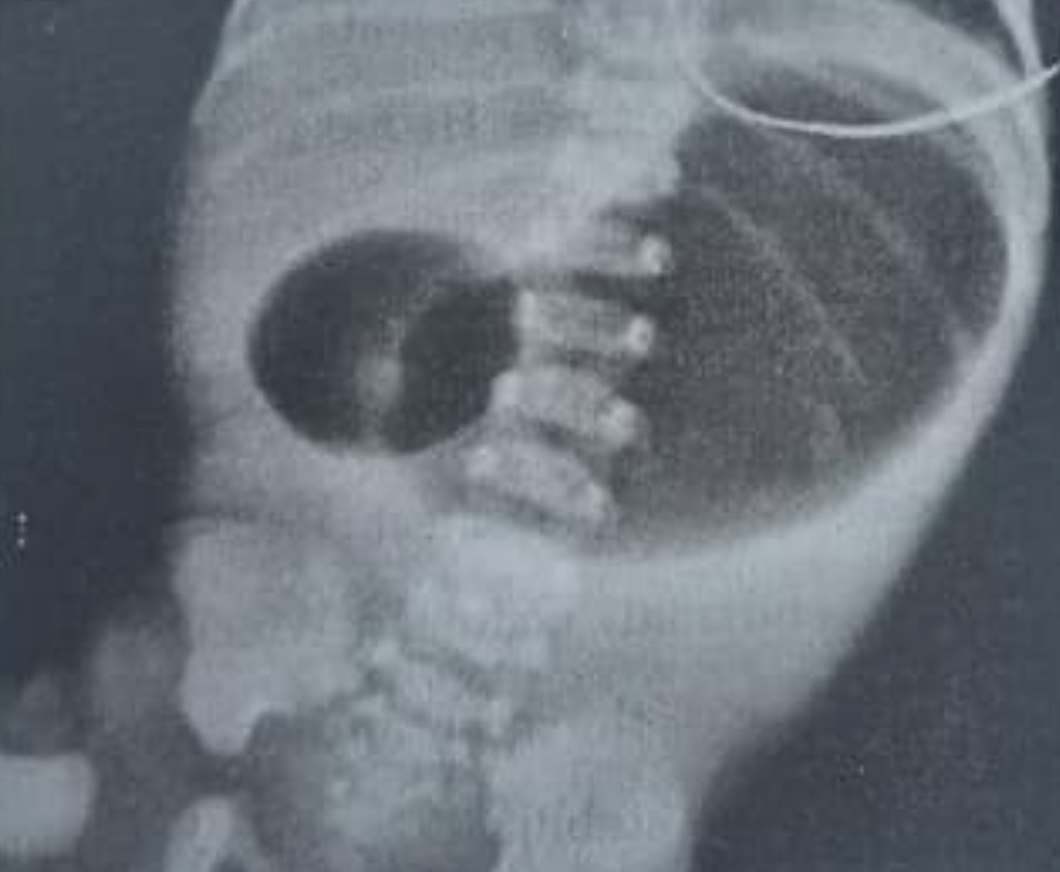
A neonate is noted to have bilious vomiting at 6 hours of life with abdominal distension. An X-ray is ordered (see image). The most likely diagnosis is:
Options:
Answer:
Question:
A 10-year-old girl presents to the emergency with high-grade fever of 2 weeks’ duration and rashes over the lower limbs for the last 7 days. Examination reveals mild pallor, generalized petechiae and hepatosplenomegaly. Investigations reveal: Hemoglobin 9 g/dL, total leucocyte count 2100/mm³, platelet count 20,000/mm³, peripheral smear shows pancytopenia, SGOT 50 IU/L, SGPT 64 IU/L, serum ferritin 1200 μg/L, serum fibrinogen 100 mg/dL and serum triglycerides 350 mg/dL. The most likely diagnosis is:
Options:
Answer:
Question:
A 5-year-old boy, started on induction chemotherapy for acute lymphoblastic leukemia, develops acute abdominal pain on day 14 of chemotherapy. On abdominal examination, there is marked abdominal tenderness and Cullen’s sign is positive. The most likely chemotherapeutic drug which can be implicated is:
Options:
Answer:
Question:
A 5-year-old boy who was started on treatment for Burkitt lymphoma develops acute onset respiratory distress and decreased urine output. Investigations reveal: Hb 8 g/dL, TLC 15,000/mm³, platelet count 1 lakh/mm³, serum potassium 6.5 mEq/L, corrected serum calcium 6.7 mg/dL and serum creatinine 2 mg/dL. The most important drug for emergency management is:
Options:
Answer:
Question:
Consider the following statements regarding human milk banking:
- The banks accept voluntary milk donations from lactating women who are given nominal payments governed by law.
- Donor mothers are screened via blood tests for HIV, Hepatitis B and Hepatitis C, similar to blood donation.
- Pasteurized donor milk reduces the chances of necrotizing enterocolitis (NEC) in preterm neonates.
- Pasteurized donor milk is non-inferior to fresh mother’s own milk (MOM).
Options:
Answer:
